For Fear of an Elective King by Kathleen Bartoloni-Tuazon
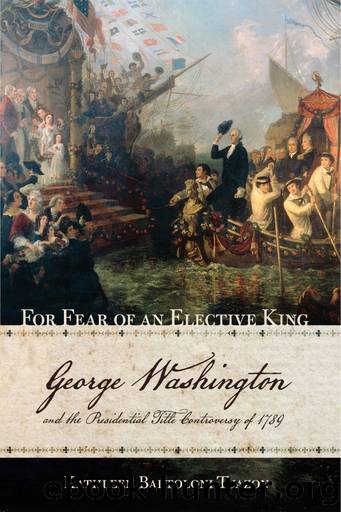
Author:Kathleen Bartoloni-Tuazon [Bartoloni-Tuazon, Kathleen]
Language: eng
Format: epub
Tags: Biography & Autobiography, Presidents & Heads of State, History, United States, Revolutionary Period (1775-1800), World, Americas (North; Central; South; West Indies), Political Science, General, History & Theory, American Government, Executive Branch, Reference, Etiquette
ISBN: 9780801471919
Google: XY5HDwAAQBAJ
Publisher: Cornell University Press
Published: 2014-09-04T03:34:07+00:00
CHAPTER 6
A âDangerous Viceâ
Leaders under Scrutiny
The Constitution and the governance it envisioned remained unproven in the spring of 1789. This was especially true with regard to the protection of the peopleâs liberties. The public sought an ideal of executive authority that would remain anchored in popular sovereignty and yet steer the country to an eminence that matched its boundless potential. The examples of conduct set by federal leaders not surprisingly influenced the consideration of political leadership within the public debate over executive titles. George Washington and John Adams, in particular, provided the public with contrapuntal models that informed the discussion of desirable traits for a national leader.
The slings and arrows of critical opinion aimed with especially devastating precision at John Adams. The strictures against him ranged far beyond Ralph Izardâs now infamous âHis Rotundityâ insult, which may have been familiar only to congressional elites and their confidants.1 More damning, Adams became branded as the âdangerous Vice,â a biting epithet derived from a long poem of the same name that offered a punning critique of both his monarchist vice of promoting a regal executive title and the vice presidential office he held. The poem, entitled âThe Dangerous Vice---------,â provocatively linked the evils of monarchy with the titles champion a heartbeat away from the presidency.2
Although Adams dreaded the real possibility of an aristocratic Senate cabal that would manipulate and corrupt the president, his efforts to increase the energy of the executive through what critics viewed as ânauseous titlesâ appeared monarchical to the people.3 His reputation suffered immediate and long-term damage, and he became the butt of jokes among legislators. Influential Virginia judge and future William and Mary professor St. George Tucker found the title debate so ludicrous that he skewered Adams in an unpublished play. Newspaper opinion toward Adams varied. But he received such scathing press coverage that, at times, his defenders protested the brutal level of the attacks more than the criticism itself.4
Washington presented the public with a much different and more complex dynamic. Throughout the title controversy, he continued to embody one of the great dichotomies of the early Republicâalthough accolades and addresses with regal and divine undertones of Washingtonâs third body of sovereignty remained the norm, the public saw him as an iconic and powerful republican who disdained titles. Most Americans maintained confidence in both his âmoderationâ and his opposition to âinsulting peagentry.â As a result, despite the court culture enveloping him (and the presidency), Washington buffered the early presidency from attack as a monarchical institution capable of corruption or the abuse of power.5
When the people considered Washingtonâs example within the debate over an executive title, a picture of an ideal president emergedâone that had Washingtonâs traits but that rejected the kingly enthusiasm associated with him. The modest title of âPresidentâ reflected both Washingtonâs widely admired appearance of modesty and the countryâs preference for a lack of pageantry, a preference that he countenanced. Washingtonâs support of the peopleâs endorsement of a simple presidential title that would tamp down monarchical
Download
This site does not store any files on its server. We only index and link to content provided by other sites. Please contact the content providers to delete copyright contents if any and email us, we'll remove relevant links or contents immediately.
| Arms Control | Diplomacy |
| Security | Trades & Tariffs |
| Treaties | African |
| Asian | Australian & Oceanian |
| Canadian | Caribbean & Latin American |
| European | Middle Eastern |
| Russian & Former Soviet Union |
The Secret History by Donna Tartt(19088)
The Social Justice Warrior Handbook by Lisa De Pasquale(12190)
Thirteen Reasons Why by Jay Asher(8909)
This Is How You Lose Her by Junot Diaz(6887)
Weapons of Math Destruction by Cathy O'Neil(6279)
Zero to One by Peter Thiel(5802)
Beartown by Fredrik Backman(5754)
The Myth of the Strong Leader by Archie Brown(5507)
The Fire Next Time by James Baldwin(5444)
How Democracies Die by Steven Levitsky & Daniel Ziblatt(5218)
Promise Me, Dad by Joe Biden(5153)
Stone's Rules by Roger Stone(5088)
A Higher Loyalty: Truth, Lies, and Leadership by James Comey(4963)
100 Deadly Skills by Clint Emerson(4925)
Rise and Kill First by Ronen Bergman(4789)
Secrecy World by Jake Bernstein(4753)
The David Icke Guide to the Global Conspiracy (and how to end it) by David Icke(4718)
The Farm by Tom Rob Smith(4509)
The Doomsday Machine by Daniel Ellsberg(4490)
